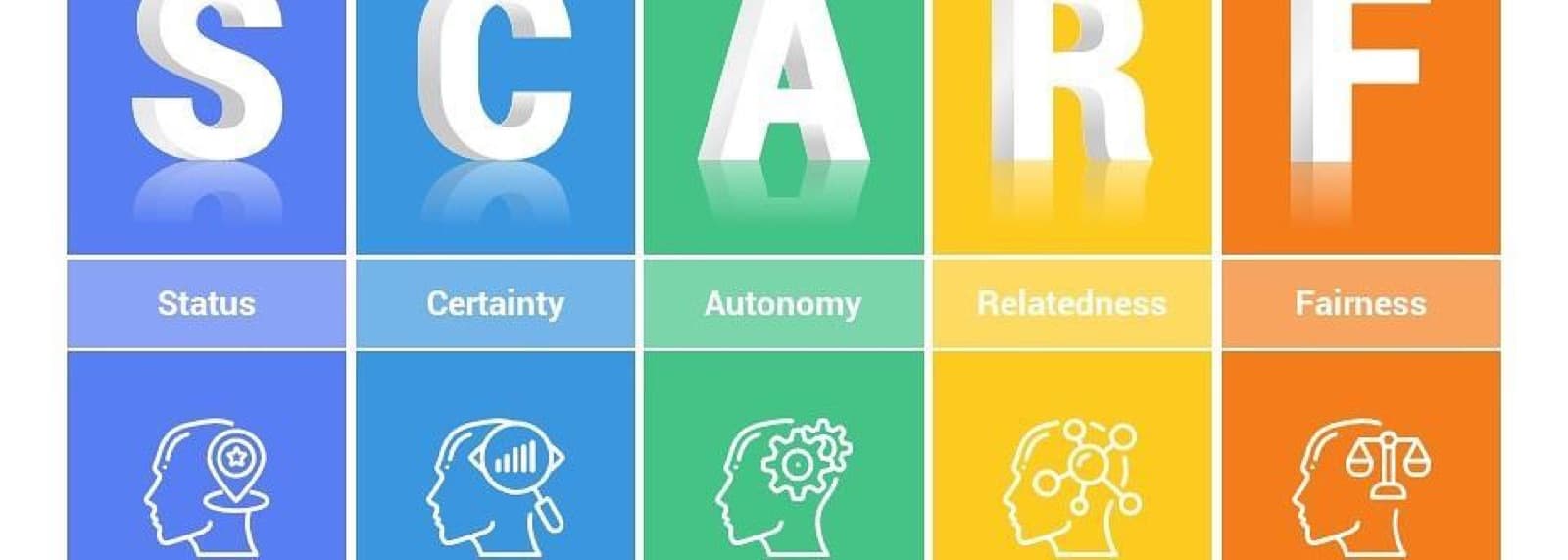
The SCARF Model: Five Triggers That Run Every Meeting
Status, Certainty, Autonomy, Relatedness, Fairness: how David Rock's SCARF model explains every tense meeting, and how to use it as a leader.
In a recent coordination session, one of my clients, a senior leader managing other managers, told me something that struck me. She said: "When my managers assess their teams, I see patterns shaped not just by performance, but by profiles, preferences, even biases. The SCARF Model really helps to describe it."
I didn't know the model, and she introduced it to me. That conversation sent me down a rabbit hole, and the deeper I went, the more I recognized what I had been watching in meeting rooms for years without having words for it: the sudden silences, the disproportionate reactions to a minor slide change, the brilliant person who stops contributing after one offhand remark.
What is the SCARF model?
SCARF was proposed by David Rock in 2008, in the first issue of the NeuroLeadership Journal. His starting point is simple and slightly unsettling: the brain processes social experiences with much of the same circuitry it uses for physical survival. A public slight or an opaque decision isn't "just" unpleasant: it triggers the same kind of away-response as a physical threat. Recognition or a sense of belonging triggers the opposite: an approach-response, like a tangible reward.
Rock organizes these social triggers into five domains:
- Status: your sense of relative importance to others
- Certainty: your ability to predict what's coming
- Autonomy: your sense of control over events
- Relatedness: feeling safe with, and connected to, others
- Fairness: the perception of fair exchanges between people
Each domain can fire in two directions: a threat state (defensive, narrow, survival-driven) or a reward state (open, creative, collaborative). And nowhere do the five fire more often than in meetings: the one place where status is visibly ranked, agendas create or destroy certainty, decisions grant or remove autonomy, alliances form, and fairness is on public display.
For leaders, the practical implication is a checklist: reduce the threats, reinforce the rewards, and you create the conditions for people to actually think.
The five triggers, one by one
Status: am I valued here?
Status is your sense of relative importance, and it's fragile. Public correction, unsolicited advice, being talked over: all of it can register as a status attack, even when nothing hostile was intended. Rock's uncomfortable observation: even the phrase "can I give you some feedback?" is enough to put most brains on alert.
- As a manager: when you rewrite someone's report instead of asking questions about it, the improvement you add is often smaller than the status threat you create.
- In a meeting: a director corrects a junior product manager's slide in front of everyone. Factually right, socially costly: the PM doesn't say another word for the rest of the hour, and the room noticed.
- Coaching question: in your last meeting, whose status did you raise or lower, and was it on purpose?
Certainty: do I know what's coming?
The brain is a prediction machine; ambiguity burns energy. Vague announcements ("there will be changes"), shifting priorities, and meetings without agendas all create a low-grade threat state that crowds out deep work.
- As a manager: announcing a reorganization "in principle" without a timeline generates weeks of corridor speculation, often more costly than the reorganization itself.
- In a meeting: no agenda, no decision rule, no end time. People spend the hour scanning for danger instead of contributing.
- Coaching question: what is your team currently forced to guess at that you could make explicit this week?
Autonomy: do I have a say?
Autonomy is the perception of choice. Micromanagement is its natural predator: prescribing the how, not just the what. Even small choices restore a sense of control, which is why autonomy is one of the strongest levers of intrinsic motivation, as Deci and Ryan's self-determination theory established long before SCARF. We explore that motivational side in Beyond Carrot and Stick.
- As a manager: delegate outcomes, not methods. "I need this decided by Friday; how you get there is yours."
- In a meeting: presenting a decision as final when people believed they were being consulted is a double hit, autonomy and fairness at once. Say upfront whether this is a consultation or an announcement.
- Coaching question: where could you hand over the "how" this week, even if you must own the "what"?
Relatedness: friend or foe?
The brain sorts people fast: in-group or potential threat. New team members, silo dynamics, remote meetings with cameras off: all tilt the sorting toward "foe", and information stops flowing.
- As a manager: skipping the two minutes of human check-in at the start of a 1:1 saves two minutes and loses the conversation.
- In a meeting: a cross-team session where each side arrives with its own deck and its own numbers. Until someone names a shared goal, it's two tribes, not one team.
- Coaching question: who in the room is still "foe" by default, and what small, genuine gesture would move them toward "friend"?
Fairness: is this exchange fair?
Unfair treatment triggers a visceral response: people will accept a personal cost to punish what they perceive as unfair. Opaque decisions, invisible criteria, rules that apply to some and not others: fairness threats corrode trust faster than almost anything else.
- As a manager: a promotion decision can be entirely defensible and still destructive, if the criteria were never made public.
- In a meeting: airtime. When the same two voices get most of the speaking time and all of the decisions, everyone else's brain quietly files the meeting under "rigged".
- Coaching question: could you explain the criteria behind your last unpopular decision out loud, to the whole team, without discomfort? If not, the problem may not be the decision.
Why threats weigh more than rewards
The five domains aren't symmetrical. Threat responses are faster, stronger, and longer-lasting than reward responses, and while someone is in a threat state, working memory shrinks, nuance disappears, and collaboration drops. You cannot argue someone out of a threat state with better arguments: the arguments are processed by the very circuits the threat has just degraded. The sequence matters: state first, content second.
This asymmetry explains a familiar paradox of feedback: interventions designed to help often hurt. In Kluger and DeNisi's landmark meta-analysis of feedback interventions, more than a third actually degraded performance, often because the feedback hit the person (status) instead of the task. It's the scientific backbone of what we describe in The Art of Feedback: conditions first, content second.
How do you use SCARF in a 1:1?
In our coaching sessions, we see SCARF work best in 1:1s as a design tool before and a diagnostic tool during:
- Open with an opt-in. "Would you be open to looking at Thursday's presentation together?" respects status and autonomy in one sentence.
- Ask before you advise. Questions raise status; unsolicited advice lowers it.
- Structure feedback around facts and impact (SBI), not personality: it keeps the status threat as low as the message allows.
- Co-build the plan. Solutions people author themselves protect autonomy, and actually get executed.
- Close with their commitments, not yours.
And when a 1:1 turns tense despite all this, run the SCARF scan: instead of "they're being difficult", ask "which domain did I just threaten?" A disproportionate reaction to a small process change is rarely about the process, it's usually certainty or autonomy. The scan turns defensiveness from a character judgment into a data point, and pairs naturally with the techniques in Navigating Difficult Conversations.
How do you use SCARF with your team?
- Certainty: send agendas before meetings, state explicit decision rules ("this is Marie's call, we're advising her"), keep timelines visible. In periods of change, name what is known, what is unknown, and when the next update comes: "we don't know yet, and here's when we will" beats silence.
- Status: rotate who opens, who presents, who is asked first. Catch people being competent, publicly.
- Autonomy: define the outcome and the constraints; let the team own the path.
- Relatedness: protect the human minutes at the start; build shared goals across silos before you need them.
- Fairness: publish criteria before decisions, not after. Watch airtime like a budget.
None of this is decoration. Amy Edmondson's research on psychological safety shows that teams where people feel safe to speak up learn faster, and a SCARF-literate leader is, in practice, building exactly that safety, trigger by trigger.
What are the limits of the SCARF model?
We'd be poor practitioners if we sold SCARF as more than it is.
- It's a synthesis, not a measurement instrument. Rock's 2008 paper organizes existing neuroscience into a usable mnemonic; SCARF itself is not a validated psychometric test, and you shouldn't score people with it.
- Sensitivity varies. One person's minor process change is another's certainty crisis. The model names the domains; it doesn't tell you how much each one weighs for the person in front of you. Ask.
- It overlaps with older theories. Autonomy and relatedness come straight from self-determination theory. SCARF's real contribution is the packaging: five triggers you can actually remember in the room, which is also its value.
- It can be misused. Read as a manipulation manual ("stroke status to get compliance"), it backfires: people detect instrumental warmth quickly. Use SCARF to design conditions, not to engineer people.
- It doesn't replace the conversation. SCARF lowers the friction; it doesn't deliver the difficult message for you.
My client was right that day: what looks like performance assessment is often profile, preference, and bias, five triggers firing under the table. Leaders who see the triggers stop taking the reactions personally, and start designing meetings where brains can actually work.
Before your next tense meeting, try a two-minute SCARF scan: which of the five domains is most at risk, for whom, and what one sentence would defuse it? Then rehearse that sentence out loud. Practice it with Lumia, your AI coach: describe the meeting, run the scan together, and test your opening line before the room does.
Frequently asked questions
What does SCARF stand for?
SCARF stands for Status, Certainty, Autonomy, Relatedness, and Fairness: the five social domains that David Rock identified in 2008 as triggering strong approach or avoid responses in the brain. Each domain can produce a threat state, which narrows thinking and collaboration, or a reward state, which opens them up.
Is the SCARF model scientifically validated?
SCARF is a synthesis, not a psychometric instrument. David Rock's 2008 paper organizes findings from social neuroscience into a memorable framework, and its components rest on established research: autonomy and relatedness echo self-determination theory, for example. But SCARF itself is a practical mnemonic for leaders, not a validated test, and it shouldn't be used to score or label people.
How do I use the SCARF model in a meeting?
Design the conditions before the content: send an agenda (certainty), state who decides and how (fairness, autonomy), rotate who speaks first (status), open with a genuine human minute (relatedness), and make decision criteria public (fairness). During the meeting, treat disproportionate reactions as data: ask which of the five domains was just threatened rather than judging the person.
What is the difference between SCARF and self-determination theory?
Self-determination theory (Deci and Ryan) is a validated theory of motivation built on three needs: autonomy, competence, and relatedness. SCARF borrows two of those, adds status, certainty, and fairness, and reframes everything through the brain's threat-reward lens. SDT explains what sustains motivation over time; SCARF is a field checklist for what triggers people in real time.
References
- Rock, D. (2008). SCARF: A Brain-Based Model for Collaborating with and Influencing Others. NeuroLeadership Journal, 1(1), 44–52.
- Ryan, R. M., & Deci, E. L. (2000). Self-determination theory and the facilitation of intrinsic motivation, social development, and well-being. American Psychologist, 55(1), 68–78. DOI: 10.1037/0003-066X.55.1.68
- Kluger, A. N., & DeNisi, A. (1996). The effects of feedback interventions on performance. Psychological Bulletin, 119(2), 254–284. DOI: 10.1037/0033-2909.119.2.254
- Edmondson, A. C. (1999). Psychological Safety and Learning Behavior in Work Teams. Administrative Science Quarterly, 44(2), 350–383. DOI: 10.2307/2666999